
Distributed campus sensors
Extend the weather scenario to greenhouse or building sensors and investigate data freshness across many small updates.
The same radio site can become a teaching lab, a network experiment or the access point for campus sensors. Each scenario connects a practical task with something measurable.
The campus weather station uses the private 5G network to access the campus data service. The RUT976 connects the sensor application to the core network and the existing weather platform.
EquipmentCampus weather station, Teltonika RUT976 and the 5G platform.
The station sends its data to the RUT976 over Ethernet. Through the private 5G connection, the data reaches the campus data service and weather dashboard. Router telemetry adds connection information alongside the application data.
The implemented data path supports experiments on data freshness, outages and recovery. Further work can compare 5G with Wi-Fi and correlate weather readings with router telemetry and core events.
Scroll sideways to explore the diagram, or open the full-size version.
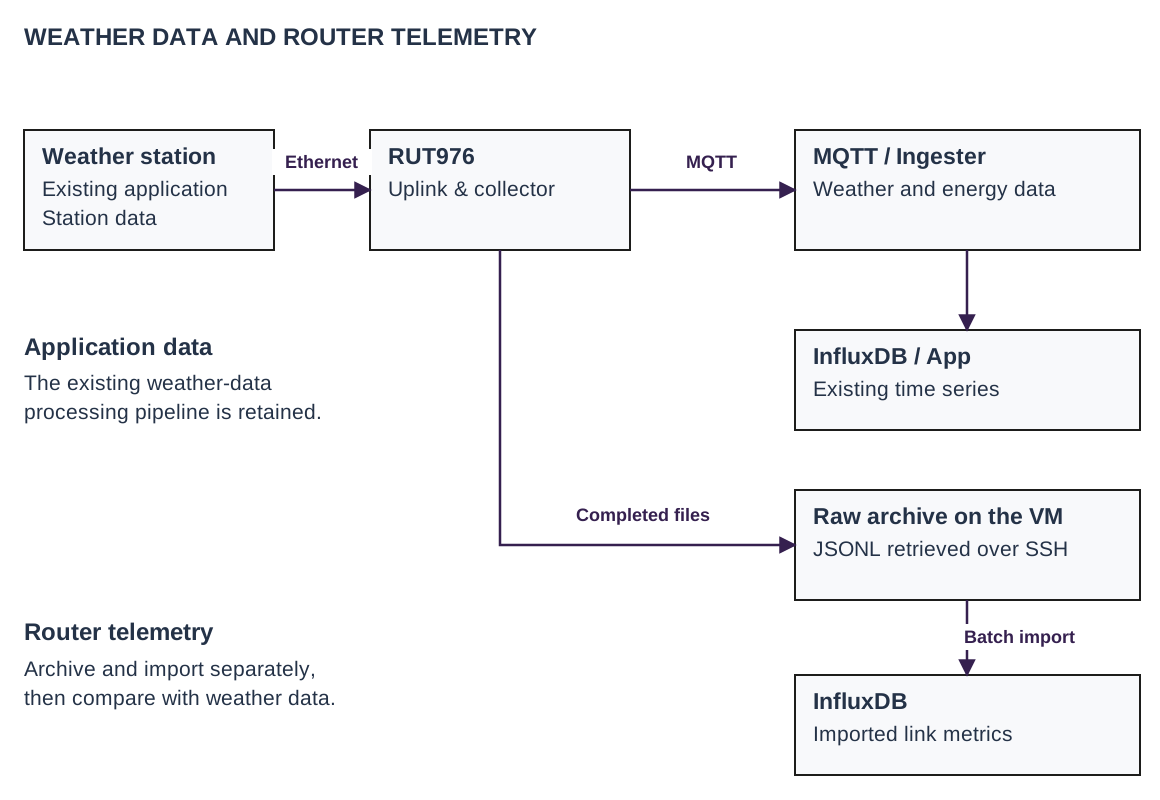
The weather data path through the RUT976 and the private 5G network is implemented. Weather data and router telemetry can be analysed separately and compared over time.
Visit the campus weather station ↗Turn mobile-network concepts into a sequence students can follow on physical equipment.
EquipmentCommissioned test SIMs, Android/iOS phones or a Linux modem, and the researcher monitoring tools.
Register a device, establish a PDU session and open a campus application. Relate each step to AMF/SMF events and traffic at the UPF. Then diagnose a prepared configuration or connectivity fault.
Separate radio access, subscriber authentication, session setup and application reachability. Students can explain which observation supports each conclusion.
Use a documented baseline to investigate what changes when the device, backhaul or workload changes.
EquipmentSC-418, Open5GS, Quectel RM520N-GL, Android and iOS test devices.
Repeat a defined traffic profile with fixed duration, server and radio conditions. Compare direct Ethernet with the router backhaul, then investigate device registration and application behaviour.
Measure throughput, RTT, reconnect behaviour and telemetry together. Separate controlled measurements from one-off functional tests; preserve logs and configuration for comparison.
These are candidate experiments for future student projects and research, not capabilities already demonstrated by the platform.
Extend the weather scenario to greenhouse or building sensors and investigate data freshness across many small updates.
Study the relationship between uplink load, delay and application quality using a campus video-processing endpoint.
Explore device movement and intermittent connectivity in supervised experiments. Continuous mobile coverage and handover would require additional work.
A further research direction: investigate QKD-assisted key distribution for encryption of the N2/N3 transport between the radio site and the campus core.
Explore the QKD concept →A good starting point is a device, a measurable outcome and a repeatable test procedure.